


Puck published an amusing piece by Kim Masters this week on David Zaslav’s “Hamptons pipeline” that’s benefitted filmmakers like Ed Burns, honorary Hamptonite Nancy Meyers, and Nick Pileggi. The dek made me laugh: “Over 75, summer in the Hamptons, and have an old script lying around? Congratulations, David Zaslav at Warner Bros. may have just greenlighted your project.”
Deals that get made here affect the entertainment industry at large. That’s also true in politics, finance, sports, and fashion. When powerful people and decision-makers are “off,” supposedly relaxing at the beach, on the golf course, or at dinner parties, they’re often plotting. It’s part of the reason I wanted to start reporting more on this area: It’s a string of small towns with global impact.
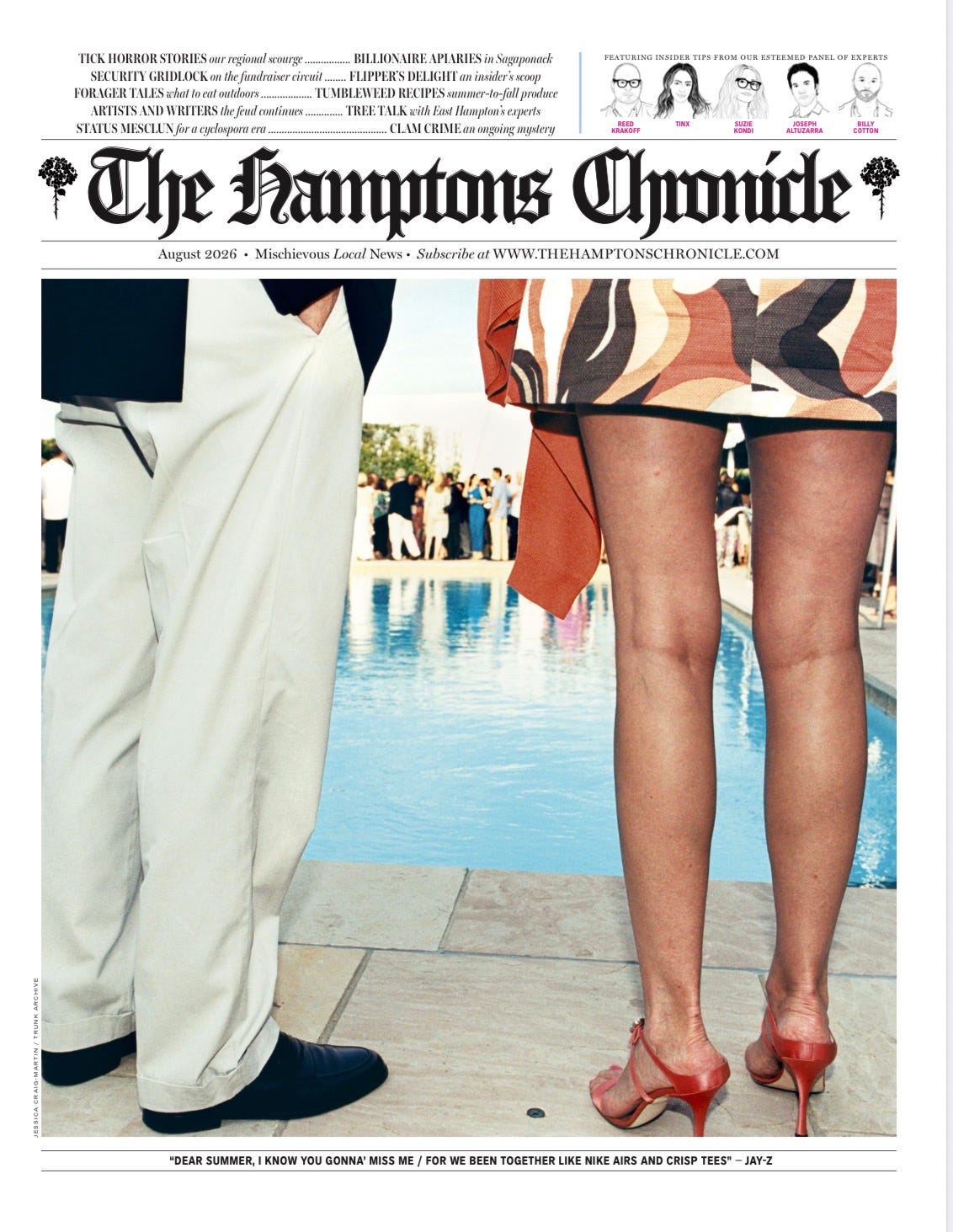
I’m excited to share the cover of The Hamptons Chronicle’s second print issue, with a photograph from the great Jessica Craig-Martin’s 2007 series “American Summer.” If you were one of the many people I spoke to who watched Barbara Kopple’s 2002 documentary “The Hamptons” this summer, you’ll recognize the Y2K-era catering and footwear tropes.
The photographer, whose memoir will be out in November, revisits the series for THC: “I focus my lens on pockets of extreme wealth and privilege. The Hamptons beckoned, representing as they do the old world northeast WASP high society, with their genteel frayed collars, blue blazers and notoriously “exclusive” (ahem) beach clubs, and the nouveau-riche hedge funders with their art collections, Patek Philippe “cheeseburger” watches, and Humvees—cars made to drive over villages rather than through them. The Hamptons have long been an ultimate place to display American wealth. But what do these people do for fun? Hoping to find out, I spent a summer attending local events.”
Regarding the photo featured on the cover, “Real WASPs, Wrong Party,” she says, “On entering the event, this true WASP couple paused. I felt they were assessing the flashy crowd. They shortly slipped away, having decided this was not their sort of function.”
I’ve been dropping the paper at locations including Sagaponack General Store, Marie Eiffel, and Jack’s and TWP in Sag Harbor (follow along on Instagram for more drop spots). If you’re not local and interested in seeing it, I’m running a promotion through the end of the weekend: Annual newsletter subscriptions are 20% off, and I’ll send you the first two print papers. Link here.
In today’s (free) newsletter, Whoopi Goldberg will have a five-star weekend on Shelter Island this September, everything you need to know about the John Mayer concert, and a look at The Full Ask, the new real-estate platform that’s taken over your algorithm.
What Everyone’s Talking About This Week (Aside from Gwyneth Postponing Her Sam Altman Dinner)
Debate over Flock cameras is rising nationally, with a cosplayer dressed as Darth Vader recently giving a satirical speech defending them in San Diego. Jack Motz details recent developments in East Hampton’s Flock fight. On Shelter Island, locals are concerned about proposals to install them near Sunset Beach.
’Women Like Us,’ a Netflix movie executive produced by Michelle Obama starring Whoopi Goldberg, Vivica A. Fox, and Vanessa Williams, will be shooting on Shelter Island this fall at locations including The Pridwin (a boon for the hotel, which has struggled to attract customers off season). The Netflix film is about a recently widowed woman whose best friends take her to the Hamptons—if it’s anything like the similarly premised “The Five-Star Weekend,” I’m in.
Newlywed Travis Kelce is in town shooting photos for Tommy Hilfiger at the former Paul Morrissey and Andy Warhol estate in Montauk.

Scene Report from the John Mayer Concert
My former colleague Taylor Ford, InStyle’s social-media supernova and a dyed-in-the-wool John Mayer fan, reports on one of the events of the summer:
As a 12-year-old girl who first experienced the feeling of being horny to the No Such Thing music video on MTV2 while getting ready for Roslyn Middle School, when I got served an IG contest that John Mayer would be playing a private show at Stephen Talkhouse (all of my safe words) I immediately started coming up with ways to tell my husband that it was time to use my hall pass reaching out to every contact I had at SiriusXM, Uber and Talkhouse to score a media credential on behalf of my role at InStyle Magazine. Luckily one came through (thank you Uber, sorry husband!) and I was already wearing my complimentary sweatshirt double-fisting Talkhouse Encores before the 7pm SHARP show start time when Andy Cohen gave a brief intro to “America’s boyfriend,” John Mayer. I was about seven rows back from the stage for the first notes of the “Last Train Home” opener, but was still distracted by wanting to turn back to the VIP area to see if I could tell if Josh Hart was grooving to the Dead & Co.-inflected jams of JM’s full band alongside Hamptons mainstays Howard Stern, Christie Brinkley and daughter Sailor Brinkley Cook, Brooke Shields, Neil Patrick Harris, and the bartender from Townline BBQ. Mayer did Seinfeldian bits between songs as he does on SiriusXM show “Life With John Mayer,” and encored with a Dolly Parton guitar interlude in ‘Gravity.’ While the closest I’ll get to Slow Dancing In A Burning Room with my every-summer-since-2001 crush was in that hot tent, I really felt in the words of Andy Cohen—that I had won the Golden Ticket.

A Cottage Industry
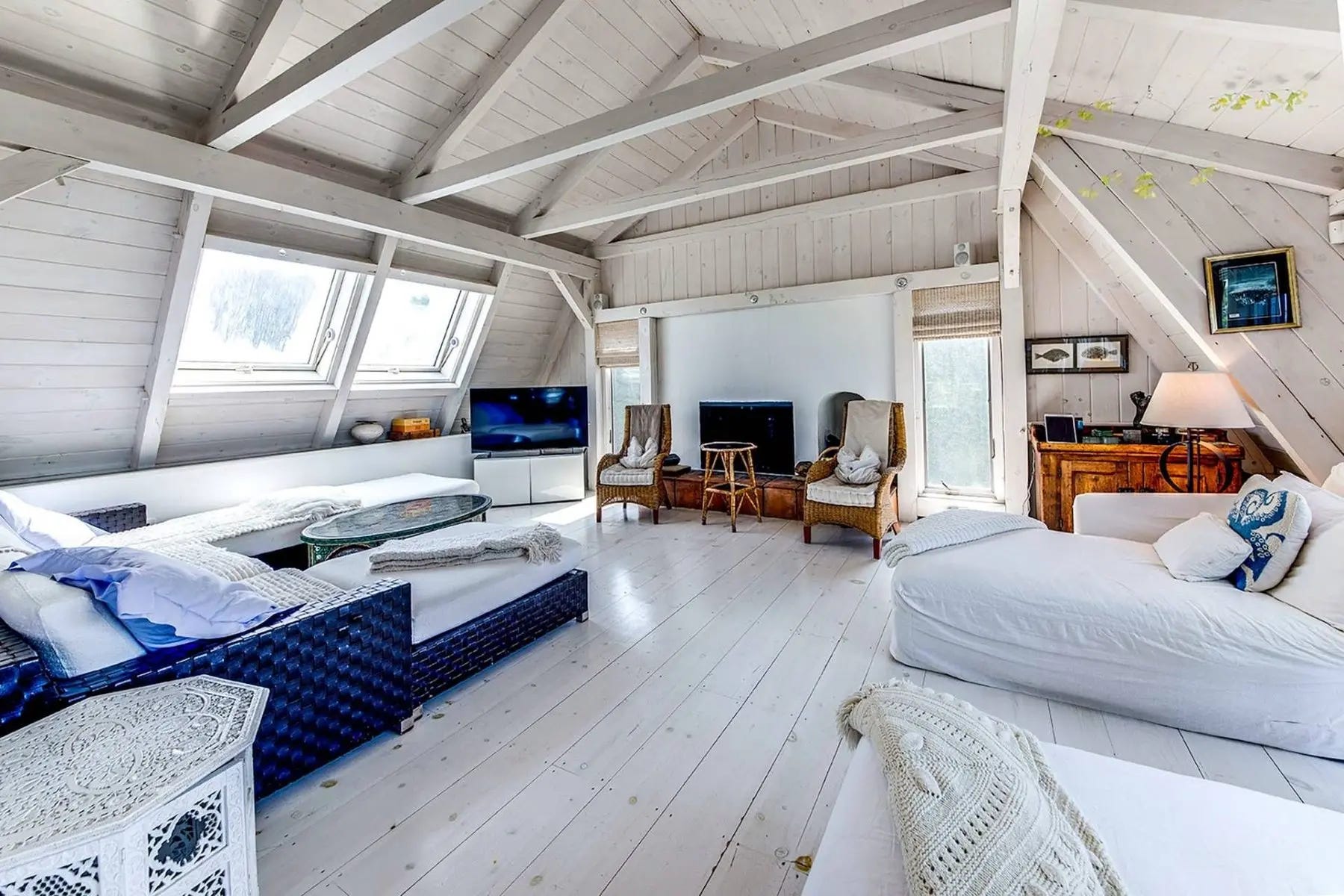
Real-estate media is booming, with the savviest agents and brokerages like The Modern House becoming content producers in their own right. Add to that the endless house tour videos in the vein of Caleb Simpson, and it’s a frothy stew. Rob Goldstein, a former Manhattan real-estate agent who’s worked in product development at tech startups, created The Full Ask platform this summer to be a “marketplace” of listings. The vibey properties, many of them in Manhattan and the Hamptons, are catnip for the kind of person who has a great source for vintage Berber rugs and wouldn’t be caught dead with an Eames lounge chair. A recent Instagram post for a “Shelter Island Art Barn” attracted interest from the likes of Cat Power. Here’s Rob on how he’s using AI and his own eye to create a one-man farmhouse hype factory.
How do you curate the selection of properties?
The curation starts with some AI agents I’ve built for myself to browse the internet and find properties that have different elements to them—whether that’s a keyword like a beam, or a designer attached to the property. From there, there’s a human curation part, which is me. I go through them and hand-select the ones I think will resonate with the audience I’m building.
How would you describe your demographic?
Mostly people who are architecturally curious. You don’t necessarily have to be in the market selling or buying, but you have a strong appreciation for real estate that is well considered. That’s another way of saying curated. I don’t like using the word curated, it’s overused.
We’re looking for approachable. Not in the millions and millions of dollars. Something where people don’t feel out of touch with what they’re looking at. I see that in the data and the impressions on the posts we get: Cottages and small villas with a ton of character perform the best. That informs what should be posted next.
How is your audience split between people looking for eye candy and people actually in the market for a house?
At the end of the day, I’m looking to build a marketplace. That doesn’t mean that if you’re looking two years out you can’t use this as a tool to find inspiration. People can also use my Instagram and the marketplace if they’re renovating their home. A lot of people comment asking where a couch or a chair is from, and I find that interesting.
But the core usage is being built for people to connect with the listing agent directly on homes they really like, so they can go see them in person. Naturally that provides value to the agent and the seller, getting it in front of an audience that might appreciate it more than if you just dropped that listing on Zillow and got mixed up with all these different listings.
What’s the business model?
Right now we accept submissions from all different personas, from an agent, which is the primary submission route, to a developer or an interior designer. We’ve had photographers submit their work on listings. There’s a fee for that placement, and the placement can take different sizes. We sell placement on the website homepage, placement in our newsletter that goes out every Sunday morning around 8:30, and then the Instagram posts, which feed into all of that. Initially I was charging around $40, and that was the only option for a post. Now it’s grown to somewhere between $350 and $2,500 depending on the placement. If a home is, say, $10 million, the cost for a post will be slightly more than if a home is priced at, say, $1 million.
How do you see content fitting into the real estate industry right now?
People tend to see what’s out there and not love it, because of how people position things. We are not the type of brand that wants to jump in front of a camera and start shouting at you on TikTok. We want slow music and cool imagery, and to just do things differently.
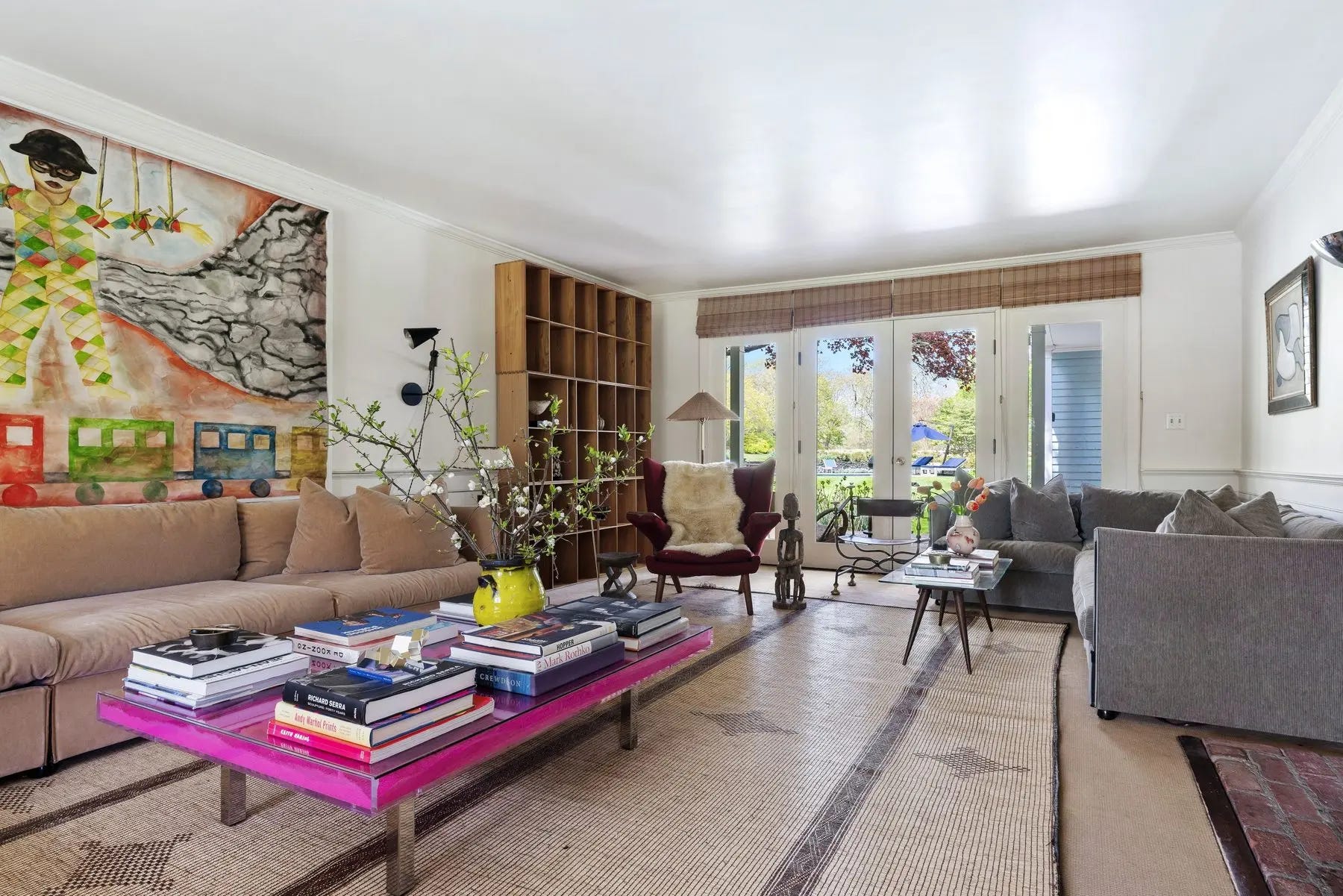
So we’ve been starting to do a little bit of media production on some of the properties we’re posting. We want the media to align with the property. For example, we recently shot a house up in Cornwall, Connecticut. It had a lot of cool features and was very vintage, so we shot the whole thing on film. That’s not something I’ve really seen done; most real estate photographers stand in the corner with a wide-angle lens, hit the button a bunch of times, and call it a day. We incorporated film and also added some life to the property to show it being more lived in. The pillows don’t have to be perfect. The dog can stay where it is, lying down. So it’s a bit more relatable and less sterile.
I saw a Shelter Island art barn listing blow up recently on your Instagram. Why do you think that particular property popped off?
There’s a very tight-knit community when it comes to artists supporting artists, and the internet has network effects — sharing, commenting, things like that. And it’s also the property itself. The way we present it is much different from how the listing would live on “insert brokerage name here.” If the property is about a painter who lives there and that history, we want the imagery to speak to that. We don’t want to show drone imagery that doesn’t show the paintings of the person who lives there. We want to lean into the cool aspects of the home. When you have big names commenting, that obviously helps other people jump into the comments too.
It is interesting to see high-profile people commenting “link, please.” You’d think they’d be more concerned with privacy.
I’d agree with you. But it’s lighthearted, in the sense that it’s not like they’re saying they’re buying it. They could want the link simply to learn more, because the listing pages are structured to be a bit editorial as well. Someone might be interested in who the painter is that we’re referencing in the caption.
If you know someone who would like The Hamptons Chronicle, please share it with them! Support local news. 💙
This was so so fabulous